
$25 OFF SERVICE FOR NEW CUSTOMERS!
(954) 405-9043
How to Get Rid of Mice in Your Home and Keep Them Out
December 23, 2025

The most effective way to get rid of mice in your home and keep them out is to remove what attracts them, block how they get inside, and use professional exclusion to prevent repeat infestations. Natural prevention steps help, but they work best when paired with expert inspection and sealing.
Mice may look small, but they cause big problems. They chew wires, contaminate food, and spread bacteria.
Many homeowners do not realize how quickly a small mouse issue can turn into a serious infestation. The key is acting early and focusing on long-term prevention, not just short-term fixes.
How Do You Know If You Have Mice in Your Home?
Mice are experts at staying hidden. Many infestations go unnoticed until the problem is already established.
Early signs homeowners often miss
Small, dark droppings along walls or inside cabinets
Scratching or movement sounds at night
Gnaw marks on food boxes, baseboards, or wires
Shredded paper, insulation, or fabric used for nests
A persistent musty smell in enclosed spaces
Mice typically travel along walls and tight spaces, which is why droppings often appear near edges rather than in open areas. Seeing a mouse during the day can indicate a larger population competing for space.
Why Mice Are Entering Your Home in the First Place
Mice do not enter homes randomly. They are driven by survival.
The three main reasons mice move indoors
Food
Even small crumbs or pet food can support mice. Open packaging and cluttered pantries make access easy.Shelter
Wall voids, attics, and basements offer quiet nesting areas that predators cannot reach.Warmth
As temperatures drop, homes provide stable indoor heat that mice cannot find outdoors.
Once mice find these conditions, they rarely leave on their own.
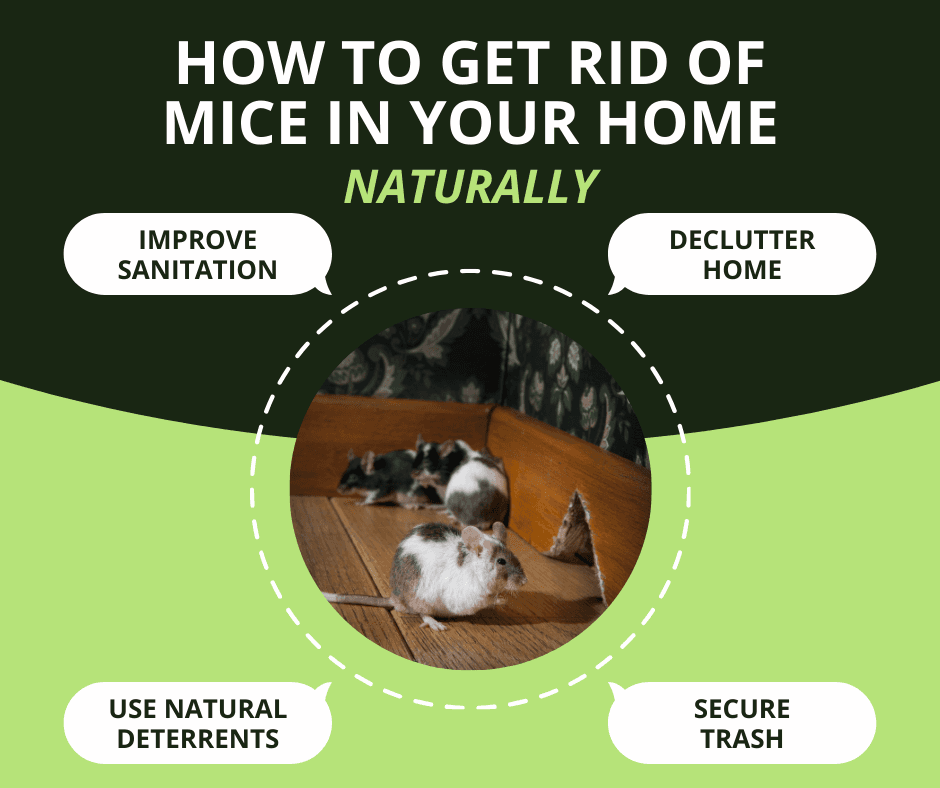
How to Get Rid of Mice in Your Home Naturally
Natural methods can reduce mouse activity and support prevention efforts. They are most effective in early stages or as part of a larger plan.
Step one: Improve sanitation
Store food in sealed containers
Clean crumbs and spills daily
Do not leave pet food out overnight
Secure trash cans tightly
Step two: Reduce hiding places
Declutter storage areas
Replace cardboard boxes with plastic bins
Keep items off the basement and garage floors
Step three: Use natural deterrents carefully
Some homeowners try scents such as peppermint oil, vinegar, or cedar. These may discourage mice from specific areas, but do not eliminate an infestation. Scents fade quickly, and mice often adapt.
Important reminder: Natural solutions do not stop mice from entering your home. They only reduce comfort once mice are already inside.
What Does Not Work Long Term for Mouse Control?
Quick fixes are appealing, but many lead to frustration.
Common solutions that fail over time
Ultrasonic repellents that mice ignore
Over-the-counter traps without sealing entry points
Poison baits that create odor and safety risks
Temporary sprays and granules
Poison is especially risky. Dead mice may remain hidden in walls, causing strong odors and attracting insects. Poison also does nothing to prevent new mice from entering.
How Mice Get Inside Your Home and Where to Look
Mice can squeeze through openings as small as a dime. Homes often have more access points than homeowners realize.

High-risk entry areas
Gaps around doors and windows
Cracks in foundations or siding
Utility lines and plumbing penetrations
Attic vents and crawl space openings
Below is a helpful overview of common risk areas.
Area of Home | Entry Risk | What to Inspect |
Foundation | Cracks or gaps | Seal with rodent-resistant materials |
Doors | Worn weather stripping | Replace or adjust |
Attic | Vent screens | Repair or reinforce |
Garage | Door gaps | Install door sweeps |
Improper sealing can trap mice inside walls or push them deeper into the structure. This is why residential inspection matters.
How Professional Mouse Exclusion Stops Infestations for Good
Exclusion focuses on prevention first, not just removal.
What professional exclusion includes
Full interior and exterior inspection
Identification of active and potential entry points
Sealing with chew-resistant materials
Safe removal of existing mice
Recommendations to reduce future attraction
Why exclusion works better
Professionals understand mouse behavior. They know where mice travel, nest, and enter. This knowledge allows them to create a complete barrier instead of addressing one visible issue at a time.
Homes that rely only on traps often experience repeat infestations. Exclusion breaks the cycle.
When to Call a Professional
DIY methods can help early, but there are clear signs it is time for professional help.
Call a professional if you notice:
Continued droppings despite cleanup
Noises in walls or ceilings
Chewed wiring or insulation
Multiple mouse sightings
Concerns about health or safety
Mice can spread bacteria such as Salmonella and contaminate surfaces. They also chew wires, increasing fire risk. Waiting often leads to higher repair costs.
How to Keep Mice Out of Your Home After Treatment
Prevention does not stop once mice are removed.
Simple habits that reduce risk
Inspect doors, vents, and foundations seasonally
Store food properly year-round
Keep landscaping trimmed away from the home
Reduce clutter near exterior walls
Regular inspections help catch new vulnerabilities before mice take advantage.
Related Questions
How fast can mice multiply in a house?
Mice reproduce quickly. A single pair can produce dozens of offspring in a year, which is why early action is critical.
Are mice dangerous to pets or children?
Yes. Mice carry bacteria and parasites and can contaminate surfaces and food.
Can mice cause structural damage?
Mice can damage insulation, wiring, drywall, and stored belongings.
How long does professional mouse exclusion take?
Inspections begin immediately, with sealing completed once all entry points are identified.
Conclusion
Natural steps play an important role in prevention, but they rarely solve an active infestation alone. The most effective way to get rid of mice in your home and keep them out is professional exclusion that addresses how and why mice enter in the first place.
If you suspect mice or want to prevent them before damage begins, a professional inspection provides clarity and long-term protection.
Radix Pest Solutions offers thorough mouse inspections, exclusion services, and prevention plans designed to protect your home.
The most effective way to get rid of mice in your home and keep them out is to remove what attracts them, block how they get inside, and use professional exclusion to prevent repeat infestations. Natural prevention steps help, but they work best when paired with expert inspection and sealing.
Mice may look small, but they cause big problems. They chew wires, contaminate food, and spread bacteria.
Many homeowners do not realize how quickly a small mouse issue can turn into a serious infestation. The key is acting early and focusing on long-term prevention, not just short-term fixes.
How Do You Know If You Have Mice in Your Home?
Mice are experts at staying hidden. Many infestations go unnoticed until the problem is already established.
Early signs homeowners often miss
Small, dark droppings along walls or inside cabinets
Scratching or movement sounds at night
Gnaw marks on food boxes, baseboards, or wires
Shredded paper, insulation, or fabric used for nests
A persistent musty smell in enclosed spaces
Mice typically travel along walls and tight spaces, which is why droppings often appear near edges rather than in open areas. Seeing a mouse during the day can indicate a larger population competing for space.
Why Mice Are Entering Your Home in the First Place
Mice do not enter homes randomly. They are driven by survival.
The three main reasons mice move indoors
Food
Even small crumbs or pet food can support mice. Open packaging and cluttered pantries make access easy.Shelter
Wall voids, attics, and basements offer quiet nesting areas that predators cannot reach.Warmth
As temperatures drop, homes provide stable indoor heat that mice cannot find outdoors.
Once mice find these conditions, they rarely leave on their own.
How to Get Rid of Mice in Your Home Naturally
Natural methods can reduce mouse activity and support prevention efforts. They are most effective in early stages or as part of a larger plan.
Step one: Improve sanitation
Store food in sealed containers
Clean crumbs and spills daily
Do not leave pet food out overnight
Secure trash cans tightly
Step two: Reduce hiding places
Declutter storage areas
Replace cardboard boxes with plastic bins
Keep items off the basement and garage floors
Step three: Use natural deterrents carefully
Some homeowners try scents such as peppermint oil, vinegar, or cedar. These may discourage mice from specific areas, but do not eliminate an infestation. Scents fade quickly, and mice often adapt.
Important reminder: Natural solutions do not stop mice from entering your home. They only reduce comfort once mice are already inside.
What Does Not Work Long Term for Mouse Control?
Quick fixes are appealing, but many lead to frustration.
Common solutions that fail over time
Ultrasonic repellents that mice ignore
Over-the-counter traps without sealing entry points
Poison baits that create odor and safety risks
Temporary sprays and granules
Poison is especially risky. Dead mice may remain hidden in walls, causing strong odors and attracting insects. Poison also does nothing to prevent new mice from entering.
How Mice Get Inside Your Home and Where to Look
Mice can squeeze through openings as small as a dime. Homes often have more access points than homeowners realize.
High-risk entry areas
Gaps around doors and windows
Cracks in foundations or siding
Utility lines and plumbing penetrations
Attic vents and crawl space openings
Below is a helpful overview of common risk areas.
Area of Home | Entry Risk | What to Inspect |
Foundation | Cracks or gaps | Seal with rodent-resistant materials |
Doors | Worn weather stripping | Replace or adjust |
Attic | Vent screens | Repair or reinforce |
Garage | Door gaps | Install door sweeps |
Improper sealing can trap mice inside walls or push them deeper into the structure. This is why residential inspection matters.
How Professional Mouse Exclusion Stops Infestations for Good
Exclusion focuses on prevention first, not just removal.
What professional exclusion includes
Full interior and exterior inspection
Identification of active and potential entry points
Sealing with chew-resistant materials
Safe removal of existing mice
Recommendations to reduce future attraction
Why exclusion works better
Professionals understand mouse behavior. They know where mice travel, nest, and enter. This knowledge allows them to create a complete barrier instead of addressing one visible issue at a time.
Homes that rely only on traps often experience repeat infestations. Exclusion breaks the cycle.
When to Call a Professional
DIY methods can help early, but there are clear signs it is time for professional help.
Call a professional if you notice:
Continued droppings despite cleanup
Noises in walls or ceilings
Chewed wiring or insulation
Multiple mouse sightings
Concerns about health or safety
Mice can spread bacteria such as Salmonella and contaminate surfaces. They also chew wires, increasing fire risk. Waiting often leads to higher repair costs.
How to Keep Mice Out of Your Home After Treatment
Prevention does not stop once mice are removed.
Simple habits that reduce risk
Inspect doors, vents, and foundations seasonally
Store food properly year-round
Keep landscaping trimmed away from the home
Reduce clutter near exterior walls
Regular inspections help catch new vulnerabilities before mice take advantage.
Related Questions
How fast can mice multiply in a house?
Mice reproduce quickly. A single pair can produce dozens of offspring in a year, which is why early action is critical.
Are mice dangerous to pets or children?
Yes. Mice carry bacteria and parasites and can contaminate surfaces and food.
Can mice cause structural damage?
Mice can damage insulation, wiring, drywall, and stored belongings.
How long does professional mouse exclusion take?
Inspections begin immediately, with sealing completed once all entry points are identified.
Conclusion
Natural steps play an important role in prevention, but they rarely solve an active infestation alone. The most effective way to get rid of mice in your home and keep them out is professional exclusion that addresses how and why mice enter in the first place.
If you suspect mice or want to prevent them before damage begins, a professional inspection provides clarity and long-term protection.
Radix Pest Solutions offers thorough mouse inspections, exclusion services, and prevention plans designed to protect your home.
Discover Our Latest Blog Post
Stay informed with the latest tips, insights, and updates from Radix Pest Solutions.


We offer a range of professional pest control services to residential and commercial clients. Our experienced team is dedicated to keeping your property pest-free with minimal disruption to your daily life.
Phone:
E-mail:
Locations:
1940 NW 1st Ave
Pompano Beach, FL 33060
2131 Hollywood Blvd, Ste 306
Hollywood, FL 33020
2829 SW 67th Ave
Miami, FL 33155
Hours
Monday - Saturday
07:00 am – 05:00 pm
Sun Closed
*Closed All Major Holidays*
Our Services
We offer a range of professional pest control services to residential and commercial clients. Our experienced team is dedicated to keeping your property pest-free with minimal disruption to your daily life.
Phone:
E-mail:
Locations:
1940 NW 1st Ave
Pompano Beach, FL 33060
2131 Hollywood Blvd, Ste 306
Hollywood, FL 33020
2829 SW 67th Ave
Miami, FL 33155
Hours
Monday - Saturday
07:00 am – 05:00 pm
Sun Closed
*Closed All Major Holidays*
Our Services
We offer a range of professional pest control services to residential and commercial clients. Our experienced team is dedicated to keeping your property pest-free with minimal disruption to your daily life.
Phone:
E-mail:
Locations:
1940 NW 1st Ave
Pompano Beach, FL 33060
2131 Hollywood Blvd, Ste 306
Hollywood, FL 33020
2829 SW 67th Ave
Miami, FL 33155
Hours
Monday - Saturday
07:00 am – 05:00 pm
Sun Closed
*Closed All Major Holidays*
Our Services
We offer a range of professional pest control services to residential and commercial clients. Our experienced team is dedicated to keeping your property pest-free with minimal disruption to your daily life.
Phone:
E-mail:
Locations:
1940 NW 1st Ave
Pompano Beach, FL 33060
2131 Hollywood Blvd, Ste 306
Hollywood, FL 33020
2829 SW 67th Ave
Miami, FL 33155
Hours
Monday - Saturday
07:00 am – 05:00 pm
Sun Closed
*Closed All Major Holidays*
Our Services