$25 OFF SERVICE FOR NEW CUSTOMERS!
(954) 405-9043

Invasive Lizard Species in Florida to Know About
June 30, 2026

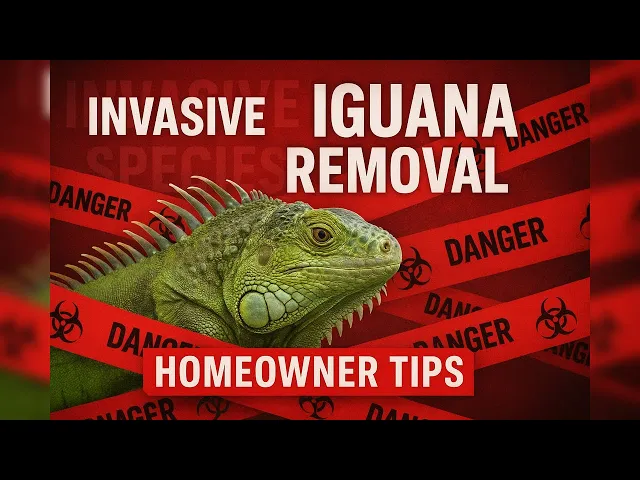
Florida has more established invasive reptile species than any other state in the country, and several of them are large lizards that are spreading rapidly through urban and suburban areas.
Whether you are a homeowner dealing with iguanas in your yard, a landscaper who just spotted a four-foot tegu on a jobsite, or simply a Florida resident trying to understand what is happening with the state's wildlife, here is what you need to know.
Why Florida Has So Many Invasive Lizards
Florida's subtropical climate is ideal for reptiles. Warm temperatures year-round, abundant food sources, and extensive natural areas create conditions where non-native species introduced through the pet trade can establish breeding populations and expand their range.
Florida has more non-native reptile species established in the wild than anywhere else on earth, including over 30 species of non-native reptiles, amphibians, and other wildlife.
Most invasive lizard introductions trace back to the pet trade: animals released deliberately by owners who could no longer care for them, or escaped from facilities. Once a population reaches breeding density in a suitable habitat, control becomes extremely difficult.
Several species that were once considered isolated problems in South Florida have now established populations across multiple counties and continue to expand northward.
The Main Invasive Lizard Species in Florida
Argentine Black and White Tegu (Salvator merianae)
The Argentine black and white tegu is among the most ecologically concerning invasive lizards currently established in Florida. Adults grow to over four feet in length and can weigh more than 15 pounds.
They have a striking black-and-white banded pattern on their body and tail, with bright green heads as hatchlings that fade after their first month.
Tegus are omnivores and opportunistic feeders that consume a wide variety of prey, but their particular threat to Florida ecosystems comes from their appetite for eggs. They actively prey on the buried eggs of native species, including sea turtles, American crocodiles, gopher tortoises, ground-nesting birds, and burrowing owls.
Research from USGS has documented tegus raiding alligator nests and turtle nests, threatening species already under conservation pressure.
Established breeding populations currently exist in Miami-Dade County, Hillsborough County, Charlotte County, and St. Lucie County. Their range is expanding. The FWC banned the import, sale, and possession of tegus in 2021 as part of new rules targeting high-risk invasive reptiles.
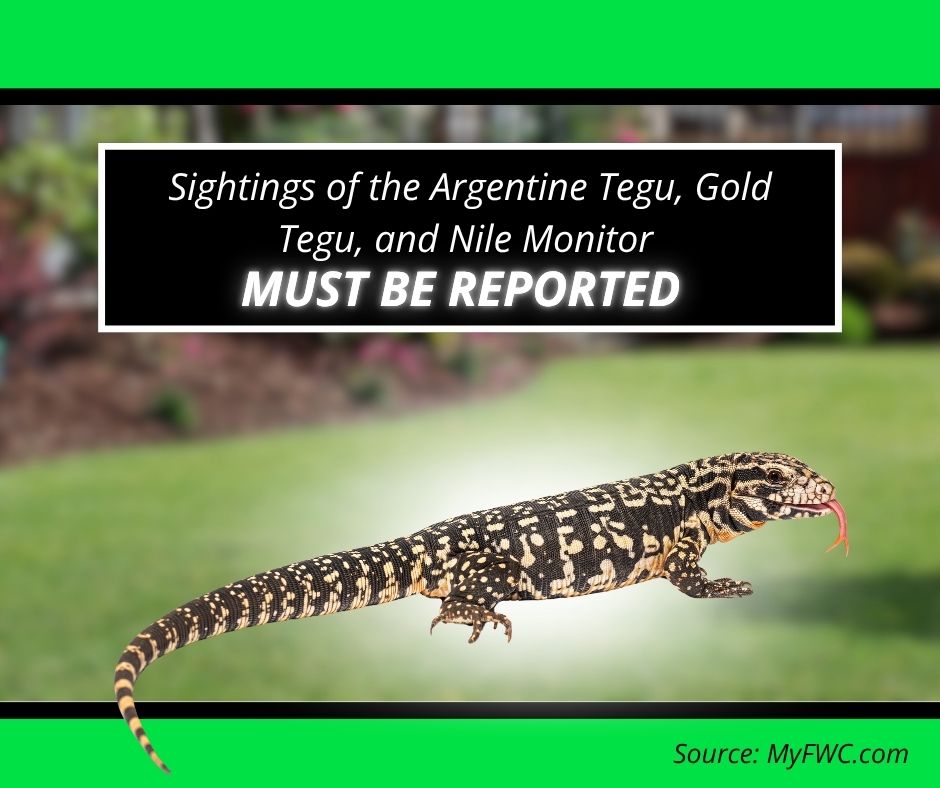
If you see a tegu, the Florida Fish and Wildlife Conservation Commission (FWC) asks that you report it to the Invasive Species Hotline at 888-IVE-GOT1 (483-4681) or online at IveGot1.org.
Green Iguana (Iguana iguana)
Green iguanas are the most widespread invasive lizard in Florida and are found throughout the southern and central portions of the state. Adults typically reach 4 to 5 feet in length. Despite their size, they are primarily herbivores that consume vegetation, flowers, fruit, and leaves.
Green iguanas' most significant damage to human infrastructure comes from their burrowing behavior.
They excavate burrows under foundations, seawalls, sidewalks, and levees, creating structural undermining that can be expensive to remediate. In waterfront communities, iguana burrows in seawalls and canal banks are a persistent and costly problem.
They are also significant pests in ornamental gardens. Iguanas consume a wide variety of landscape plants and can strip garden beds rapidly.
Unlike tegus and monitors, green iguanas are so widespread that the FWC does not require them to be reported. Homeowners on private property are allowed to remove iguanas from their own land using humane methods.
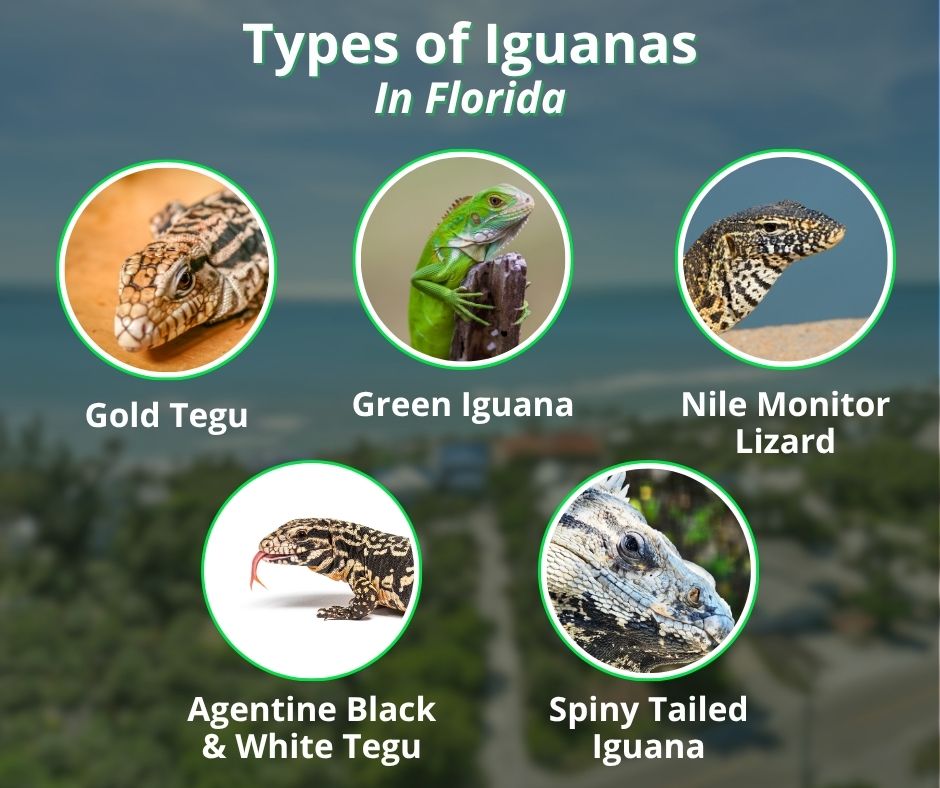
Nile Monitor Lizard (Varanus niloticus)
Nile monitor lizards are large, predatory lizards native to Africa. Adults can reach six feet or more in length and are powerful swimmers. An established population exists in Palm Beach County, centered in and around Cape Coral and West Palm Beach areas.
Nile monitors are formidable predators that consume birds, small mammals, fish, and eggs. They are a significant threat to native wildlife and have been documented raiding nests of burrowing owls and other ground-nesting species. Unlike iguanas, monitor lizards are not herbivores and pose a more direct predatory threat to native fauna.
Nile monitors should be reported immediately to FWC's invasive species hotline if encountered. They are a priority reporting species.
Gold Tegu (Tupinambis teguixin)
Gold tegus are somewhat smaller than Argentine black and white tegus, averaging 2 to 3 feet as adults. Evidence suggests established or breeding populations in Miami-Dade County.
Like the Argentine tegu, gold tegus are omnivores with a documented preference for eggs, making them a similar ecological threat to native ground-nesting wildlife.
Spiny-Tailed Iguana (Ctenosaura similis)
Spiny-tailed iguanas are black-and-white banded lizards that are somewhat smaller than green iguanas and significantly faster. They are primarily herbivores but will consume insects and small animals.
Established populations exist in several South Florida counties. Their burrowing behavior causes some of the same infrastructure concerns as green iguanas.
Ecological Threats of Invasive Lizards
The threat posed by Florida's invasive lizard community extends beyond property damage. The ecological impact is outlined in the table below.
Impact | Description & Details | Affected Species / Infrastructure |
Native Egg Predation | Threatens vulnerable populations by preying on eggs, intensifying survival pressure on already endangered species. | Sea turtles, alligators, crocodiles, and dozens of ground-nesting birds and reptiles. |
Outcompetes local wildlife for critical survival resources like food, territory, and nesting sites | Native wildlife share the same habitats. | |
Infrastructure Damage | Destabilizes structures through extensive burrowing, driving up repair costs for public and private property owners. | Foundations, seawalls, and levees (primarily driven by iguanas and tegus). |
Disease Transmission | Poses a direct zoonotic health risk to humans and handlers who do not use proper protective precautions. | Salmonella and other reptile-borne pathogens from invasive lizards. |
How to Prevent Invasive Lizard Problems on Your Property
Exclude food sources. Iguanas are attracted to fruiting plants, flowers, and vegetable gardens. Remove fallen fruit promptly, protect garden beds with barriers, and consider replacing iguana-attractive plants near your foundation with species they find less palatable.
Seal and protect burrow sites. Iguanas burrow in loose soil near water and near sunny, open areas. Hardening soil surfaces and protecting foundations with concrete or riprap reduces burrowing opportunities.
Eliminate harborage. Brush piles, stacked materials, and dense low vegetation near structures create shelter for tegus and other ground-dwelling invasive lizards. Keeping these areas clear reduces attractiveness.
Do not feed wildlife. Deliberate or incidental feeding of iguanas or other invasive lizards habituates them to human presence and concentrates populations near homes.
Reporting and Removal
Management Aspect | Guidelines & Action Protocols | Species Specifics & Safety Notes |
Reporting Requirements | Report sightings immediately to the FWC via 888-IVE-GOT1 or IveGot1.org. | Tegus & Monitors: Must be reported. Green Iguanas: No reporting is required due to widespread establishment. |
Private Property Removal | Homeowners are legally permitted to humanely remove invasive lizards from their own property. | Green Iguanas: Approved for direct humane removal. Tegus & Monitors: Professional help is recommended. Do not approach directly. Severe bite and claw risks. |
Professional Removal | Engage licensed wildlife removal professionals or permitted pest control operators. | Best utilized for large individuals, hazardous situations, or heavily established local populations. |
Related Questions to Explore
Are tegus dangerous to people? While not naturally aggressive, tegus are large and capable of severe bites and claw scratches when cornered. Keep a safe distance and report sightings to the FWC. For safe, immediate removal from your property, contact the trained handlers at Radix Pest Solutions.
Can I legally remove an iguana or tegu from my property? Yes, Florida law allows homeowners to humanely remove them, but releasing captured invasive lizards is strictly illegal. Because trapping large, defensive reptiles carries a high injury risk, DIY removal is not recommended.
Are green iguanas poisonous? No, green iguanas are not venomous, but they do carry Salmonella and can inflict painful tail-whips or bites. Handling them without proper precautions poses a direct disease and injury risk to humans and pets.
Why do invasive lizards seem to be getting bigger? Their biological size ranges haven't changed, but as invasive populations mature in Florida, encounters with full-grown adults are skyrocketing. Seeing a massive four-foot tegu or monitor lizard in your yard is increasingly common.
What is the FWC doing about invasive lizards? The FWC enforces bans, tracks sightings, and conducts research, but widespread landscape eradication is nearly impossible now. While the state focuses on macro-level management, protecting your specific property falls on you. Radix Pest Solutions bridges this gap with tailored property barriers, exclusion tactics, and active trapping.
Protecting Your Property From Invasive Wildlife
Invasive lizard management intersects with broader pest and wildlife management, particularly as tegu and iguana populations expand into new counties.
At Radix Pest Solutions, our technicians are familiar with the invasive species landscape in Florida and can advise on exclusion, harborage reduction, and when to engage licensed wildlife removal specialists.
Conclusion
The Florida Fish and Wildlife Conservation Commission maintains updated information on invasive species in Florida, including reporting tools and management resources.
If you have active iguana damage to your landscaping, potential tegu activity on your property, or broader pest and wildlife concerns, contact us for an inspection and assessment!
Florida has more established invasive reptile species than any other state in the country, and several of them are large lizards that are spreading rapidly through urban and suburban areas.
Whether you are a homeowner dealing with iguanas in your yard, a landscaper who just spotted a four-foot tegu on a jobsite, or simply a Florida resident trying to understand what is happening with the state's wildlife, here is what you need to know.
Why Florida Has So Many Invasive Lizards
Florida's subtropical climate is ideal for reptiles. Warm temperatures year-round, abundant food sources, and extensive natural areas create conditions where non-native species introduced through the pet trade can establish breeding populations and expand their range.
Florida has more non-native reptile species established in the wild than anywhere else on earth, including over 30 species of non-native reptiles, amphibians, and other wildlife.
Most invasive lizard introductions trace back to the pet trade: animals released deliberately by owners who could no longer care for them, or escaped from facilities. Once a population reaches breeding density in a suitable habitat, control becomes extremely difficult.
Several species that were once considered isolated problems in South Florida have now established populations across multiple counties and continue to expand northward.
The Main Invasive Lizard Species in Florida
Argentine Black and White Tegu (Salvator merianae)
The Argentine black and white tegu is among the most ecologically concerning invasive lizards currently established in Florida. Adults grow to over four feet in length and can weigh more than 15 pounds.
They have a striking black-and-white banded pattern on their body and tail, with bright green heads as hatchlings that fade after their first month.
Tegus are omnivores and opportunistic feeders that consume a wide variety of prey, but their particular threat to Florida ecosystems comes from their appetite for eggs. They actively prey on the buried eggs of native species, including sea turtles, American crocodiles, gopher tortoises, ground-nesting birds, and burrowing owls.
Research from USGS has documented tegus raiding alligator nests and turtle nests, threatening species already under conservation pressure.
Established breeding populations currently exist in Miami-Dade County, Hillsborough County, Charlotte County, and St. Lucie County. Their range is expanding. The FWC banned the import, sale, and possession of tegus in 2021 as part of new rules targeting high-risk invasive reptiles.
If you see a tegu, the Florida Fish and Wildlife Conservation Commission (FWC) asks that you report it to the Invasive Species Hotline at 888-IVE-GOT1 (483-4681) or online at IveGot1.org.
Green Iguana (Iguana iguana)
Green iguanas are the most widespread invasive lizard in Florida and are found throughout the southern and central portions of the state. Adults typically reach 4 to 5 feet in length. Despite their size, they are primarily herbivores that consume vegetation, flowers, fruit, and leaves.
Green iguanas' most significant damage to human infrastructure comes from their burrowing behavior.
They excavate burrows under foundations, seawalls, sidewalks, and levees, creating structural undermining that can be expensive to remediate. In waterfront communities, iguana burrows in seawalls and canal banks are a persistent and costly problem.
They are also significant pests in ornamental gardens. Iguanas consume a wide variety of landscape plants and can strip garden beds rapidly.
Unlike tegus and monitors, green iguanas are so widespread that the FWC does not require them to be reported. Homeowners on private property are allowed to remove iguanas from their own land using humane methods.
Nile Monitor Lizard (Varanus niloticus)
Nile monitor lizards are large, predatory lizards native to Africa. Adults can reach six feet or more in length and are powerful swimmers. An established population exists in Palm Beach County, centered in and around Cape Coral and West Palm Beach areas.
Nile monitors are formidable predators that consume birds, small mammals, fish, and eggs. They are a significant threat to native wildlife and have been documented raiding nests of burrowing owls and other ground-nesting species. Unlike iguanas, monitor lizards are not herbivores and pose a more direct predatory threat to native fauna.
Nile monitors should be reported immediately to FWC's invasive species hotline if encountered. They are a priority reporting species.
Gold Tegu (Tupinambis teguixin)
Gold tegus are somewhat smaller than Argentine black and white tegus, averaging 2 to 3 feet as adults. Evidence suggests established or breeding populations in Miami-Dade County.
Like the Argentine tegu, gold tegus are omnivores with a documented preference for eggs, making them a similar ecological threat to native ground-nesting wildlife.
Spiny-Tailed Iguana (Ctenosaura similis)
Spiny-tailed iguanas are black-and-white banded lizards that are somewhat smaller than green iguanas and significantly faster. They are primarily herbivores but will consume insects and small animals.
Established populations exist in several South Florida counties. Their burrowing behavior causes some of the same infrastructure concerns as green iguanas.
Ecological Threats of Invasive Lizards
The threat posed by Florida's invasive lizard community extends beyond property damage. The ecological impact is outlined in the table below.
Impact | Description & Details | Affected Species / Infrastructure |
Native Egg Predation | Threatens vulnerable populations by preying on eggs, intensifying survival pressure on already endangered species. | Sea turtles, alligators, crocodiles, and dozens of ground-nesting birds and reptiles. |
Outcompetes local wildlife for critical survival resources like food, territory, and nesting sites | Native wildlife share the same habitats. | |
Infrastructure Damage | Destabilizes structures through extensive burrowing, driving up repair costs for public and private property owners. | Foundations, seawalls, and levees (primarily driven by iguanas and tegus). |
Disease Transmission | Poses a direct zoonotic health risk to humans and handlers who do not use proper protective precautions. | Salmonella and other reptile-borne pathogens from invasive lizards. |
How to Prevent Invasive Lizard Problems on Your Property
Exclude food sources. Iguanas are attracted to fruiting plants, flowers, and vegetable gardens. Remove fallen fruit promptly, protect garden beds with barriers, and consider replacing iguana-attractive plants near your foundation with species they find less palatable.
Seal and protect burrow sites. Iguanas burrow in loose soil near water and near sunny, open areas. Hardening soil surfaces and protecting foundations with concrete or riprap reduces burrowing opportunities.
Eliminate harborage. Brush piles, stacked materials, and dense low vegetation near structures create shelter for tegus and other ground-dwelling invasive lizards. Keeping these areas clear reduces attractiveness.
Do not feed wildlife. Deliberate or incidental feeding of iguanas or other invasive lizards habituates them to human presence and concentrates populations near homes.
Reporting and Removal
Management Aspect | Guidelines & Action Protocols | Species Specifics & Safety Notes |
Reporting Requirements | Report sightings immediately to the FWC via 888-IVE-GOT1 or IveGot1.org. | Tegus & Monitors: Must be reported. Green Iguanas: No reporting is required due to widespread establishment. |
Private Property Removal | Homeowners are legally permitted to humanely remove invasive lizards from their own property. | Green Iguanas: Approved for direct humane removal. Tegus & Monitors: Professional help is recommended. Do not approach directly. Severe bite and claw risks. |
Professional Removal | Engage licensed wildlife removal professionals or permitted pest control operators. | Best utilized for large individuals, hazardous situations, or heavily established local populations. |
Related Questions to Explore
Are tegus dangerous to people? While not naturally aggressive, tegus are large and capable of severe bites and claw scratches when cornered. Keep a safe distance and report sightings to the FWC. For safe, immediate removal from your property, contact the trained handlers at Radix Pest Solutions.
Can I legally remove an iguana or tegu from my property? Yes, Florida law allows homeowners to humanely remove them, but releasing captured invasive lizards is strictly illegal. Because trapping large, defensive reptiles carries a high injury risk, DIY removal is not recommended.
Are green iguanas poisonous? No, green iguanas are not venomous, but they do carry Salmonella and can inflict painful tail-whips or bites. Handling them without proper precautions poses a direct disease and injury risk to humans and pets.
Why do invasive lizards seem to be getting bigger? Their biological size ranges haven't changed, but as invasive populations mature in Florida, encounters with full-grown adults are skyrocketing. Seeing a massive four-foot tegu or monitor lizard in your yard is increasingly common.
What is the FWC doing about invasive lizards? The FWC enforces bans, tracks sightings, and conducts research, but widespread landscape eradication is nearly impossible now. While the state focuses on macro-level management, protecting your specific property falls on you. Radix Pest Solutions bridges this gap with tailored property barriers, exclusion tactics, and active trapping.
Protecting Your Property From Invasive Wildlife
Invasive lizard management intersects with broader pest and wildlife management, particularly as tegu and iguana populations expand into new counties.
At Radix Pest Solutions, our technicians are familiar with the invasive species landscape in Florida and can advise on exclusion, harborage reduction, and when to engage licensed wildlife removal specialists.
Conclusion
The Florida Fish and Wildlife Conservation Commission maintains updated information on invasive species in Florida, including reporting tools and management resources.
If you have active iguana damage to your landscaping, potential tegu activity on your property, or broader pest and wildlife concerns, contact us for an inspection and assessment!
Check Out What Our Pest Free Customers Have To Say

Emerald Tower Association, Inc
Pompano Beach, Florida

Highly recommend them. We had issues with raccoons and Jonathan immediately came out and placed cages around the property. Caught several raccoons. Thank you Jonathan for your excellent service.

Darcy Miller
Pompano Beach, Florida
I would definitely recommend Radix Pest Solutions. Jonathan is very professional, reliable and punctual. He absolutely knows this business and takes pride in his work.

Jason Shervinski
Pompano Beach, Florida
We have had Jonathan as our exterminator for well over 7 years. We could not think of a better Pest Control company for all of properties and needs. Jonathan is prompt, detailed, and reasonable. If you are searching for a quality Pest Control Company as a one time or on a recurring basis you found it in Radix!

Emily Acevedo
Pompano Beach, Florida
Jonathan was very professional and knowledgeable, he listened and then proceeded to address the concerns. He provided excellent service and explained the process, completed it quickly and efficiently. I will be using this company again and recommend to anyone with a pest problem.

Killgates Covidlie
Pompano Beach, Florida
I’ve known Jonathan for over five years. On how he took care of us during a complete termite infestation is no less than perfection. There no one like him, bar none. His honesty, reliability, hard work and dedication and punctuality. I feel privileged that I was lucky enough to have found him to use his service, because they don’t exist like him. Thank you Jonathan.
Daisy Maestre
Pompano Beach, Florida
It’s the best pest control company that I’ve dealt with, Jonathan is knowledgeable, always prompt, courteous and thorough and very affordable. I highly recommend him…. Give him a call you won’t regret it… 😊
Emerald Tower Association, Inc
Pompano Beach, Florida
Highly recommend them. We had issues with raccoons and Jonathan immediately came out and placed cages around the property. Caught several raccoons. Thank you Jonathan for your excellent service.
Darcy Miller
Pompano Beach, Florida
I would definitely recommend Radix Pest Solutions. Jonathan is very professional, reliable and punctual. He absolutely knows this business and takes pride in his work.
Jason Shervinski
Pompano Beach, Florida
We have had Jonathan as our exterminator for well over 7 years. We could not think of a better Pest Control company for all of properties and needs. Jonathan is prompt, detailed, and reasonable. If you are searching for a quality Pest Control Company as a one time or on a recurring basis you found it in Radix!
Emily Acevedo
Pompano Beach, Florida
Jonathan was very professional and knowledgeable, he listened and then proceeded to address the concerns. He provided excellent service and explained the process, completed it quickly and efficiently. I will be using this company again and recommend to anyone with a pest problem.
Killgates Covidlie
Pompano Beach, Florida
I’ve known Jonathan for over five years. On how he took care of us during a complete termite infestation is no less than perfection. There no one like him, bar none. His honesty, reliability, hard work and dedication and punctuality. I feel privileged that I was lucky enough to have found him to use his service, because they don’t exist like him. Thank you Jonathan.
Daisy Maestre
Pompano Beach, Florida
It’s the best pest control company that I’ve dealt with, Jonathan is knowledgeable, always prompt, courteous and thorough and very affordable. I highly recommend him…. Give him a call you won’t regret it… 😊
Emerald Tower Association, Inc
Pompano Beach, Florida
Highly recommend them. We had issues with raccoons and Jonathan immediately came out and placed cages around the property. Caught several raccoons. Thank you Jonathan for your excellent service.
Darcy Miller
Pompano Beach, Florida
I would definitely recommend Radix Pest Solutions. Jonathan is very professional, reliable and punctual. He absolutely knows this business and takes pride in his work.
Jason Shervinski
Pompano Beach, Florida
We have had Jonathan as our exterminator for well over 7 years. We could not think of a better Pest Control company for all of properties and needs. Jonathan is prompt, detailed, and reasonable. If you are searching for a quality Pest Control Company as a one time or on a recurring basis you found it in Radix!
Emily Acevedo
Pompano Beach, Florida
Jonathan was very professional and knowledgeable, he listened and then proceeded to address the concerns. He provided excellent service and explained the process, completed it quickly and efficiently. I will be using this company again and recommend to anyone with a pest problem.
Killgates Covidlie
Pompano Beach, Florida
I’ve known Jonathan for over five years. On how he took care of us during a complete termite infestation is no less than perfection. There no one like him, bar none. His honesty, reliability, hard work and dedication and punctuality. I feel privileged that I was lucky enough to have found him to use his service, because they don’t exist like him. Thank you Jonathan.
Daisy Maestre
Pompano Beach, Florida
It’s the best pest control company that I’ve dealt with, Jonathan is knowledgeable, always prompt, courteous and thorough and very affordable. I highly recommend him…. Give him a call you won’t regret it… 😊
Emerald Tower Association, Inc
Pompano Beach, Florida
Highly recommend them. We had issues with raccoons and Jonathan immediately came out and placed cages around the property. Caught several raccoons. Thank you Jonathan for your excellent service.
Darcy Miller
Pompano Beach, Florida
I would definitely recommend Radix Pest Solutions. Jonathan is very professional, reliable and punctual. He absolutely knows this business and takes pride in his work.
Jason Shervinski
Pompano Beach, Florida
We have had Jonathan as our exterminator for well over 7 years. We could not think of a better Pest Control company for all of properties and needs. Jonathan is prompt, detailed, and reasonable. If you are searching for a quality Pest Control Company as a one time or on a recurring basis you found it in Radix!
Emily Acevedo
Pompano Beach, Florida
Jonathan was very professional and knowledgeable, he listened and then proceeded to address the concerns. He provided excellent service and explained the process, completed it quickly and efficiently. I will be using this company again and recommend to anyone with a pest problem.
Killgates Covidlie
Pompano Beach, Florida
I’ve known Jonathan for over five years. On how he took care of us during a complete termite infestation is no less than perfection. There no one like him, bar none. His honesty, reliability, hard work and dedication and punctuality. I feel privileged that I was lucky enough to have found him to use his service, because they don’t exist like him. Thank you Jonathan.
Daisy Maestre
Pompano Beach, Florida
It’s the best pest control company that I’ve dealt with, Jonathan is knowledgeable, always prompt, courteous and thorough and very affordable. I highly recommend him…. Give him a call you won’t regret it… 😊


We offer a range of professional pest control services to residential and commercial clients. Our experienced team is dedicated to keeping your property pest-free with minimal disruption to your daily life.
Phone:
E-mail:
Locations:
1940 NW 1st Ave
Pompano Beach, FL 33060
2131 Hollywood Blvd, Ste 306
Hollywood, FL 33020
2829 SW 67th Ave
Miami, FL 33155
Hours
Monday - Saturday
07:00 am – 05:00 pm
Sun Closed
*Closed All Major Holidays*
Our Services
We offer a range of professional pest control services to residential and commercial clients. Our experienced team is dedicated to keeping your property pest-free with minimal disruption to your daily life.
Phone:
E-mail:
Locations:
1940 NW 1st Ave
Pompano Beach, FL 33060
2131 Hollywood Blvd, Ste 306
Hollywood, FL 33020
2829 SW 67th Ave
Miami, FL 33155
Hours
Monday - Saturday
07:00 am – 05:00 pm
Sun Closed
*Closed All Major Holidays*
Our Services
We offer a range of professional pest control services to residential and commercial clients. Our experienced team is dedicated to keeping your property pest-free with minimal disruption to your daily life.
Phone:
E-mail:
Locations:
1940 NW 1st Ave
Pompano Beach, FL 33060
2131 Hollywood Blvd, Ste 306
Hollywood, FL 33020
2829 SW 67th Ave
Miami, FL 33155
Hours
Monday - Saturday
07:00 am – 05:00 pm
Sun Closed
*Closed All Major Holidays*
Our Services
We offer a range of professional pest control services to residential and commercial clients. Our experienced team is dedicated to keeping your property pest-free with minimal disruption to your daily life.
Phone:
E-mail:
Locations:
1940 NW 1st Ave
Pompano Beach, FL 33060
2131 Hollywood Blvd, Ste 306
Hollywood, FL 33020
2829 SW 67th Ave
Miami, FL 33155
Hours
Monday - Saturday
07:00 am – 05:00 pm
Sun Closed
*Closed All Major Holidays*
Our Services