$25 OFF SERVICE FOR NEW CUSTOMERS!
(954) 405-9043

What Is a Rodent and Why They Thrive in South Florida Homes
April 10, 2026
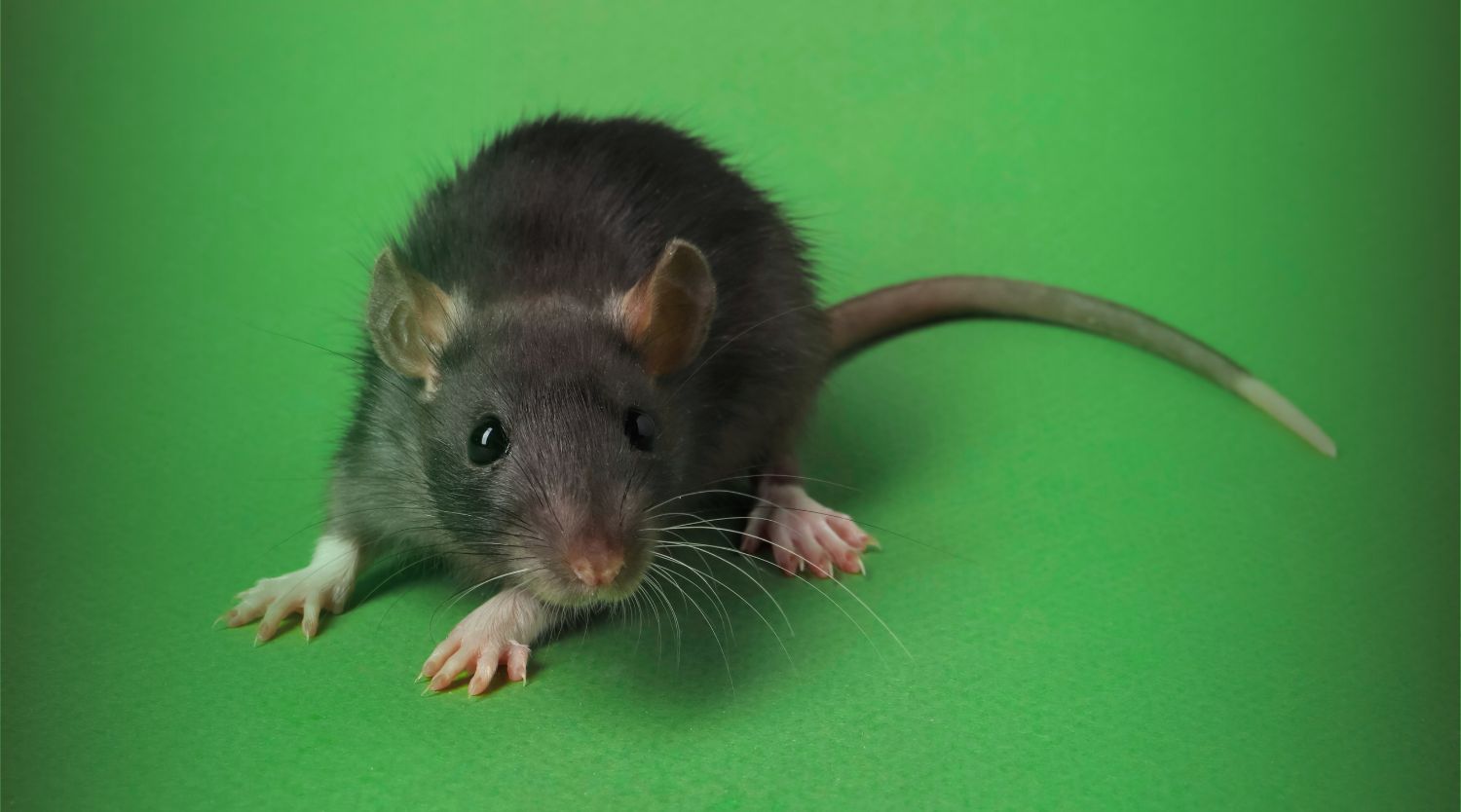
Most people have a general idea of what a rodent is. Rats and mice come to mind immediately, and for good reason. But in South Florida, the rodent picture is more specific and more persistent than most homeowners realize.
In Broward, Miami-Dade, and Palm Beach County, Radix Pest Solutions knows that rodents do not wait for winter to push indoors. The warm climate, abundant food sources, dense landscaping, and varied construction styles throughout the region support rodent activity in every season.
What Is a Rodent? Definition and Key Traits
Rodents are a group of mammals characterized by a single pair of continuously growing incisors in each of the upper and lower jaws. They are typically small animals with robust bodies, short limbs, and long tails. A rodent is a mammal belonging to the order Rodentia, the largest group of mammals on Earth, with more than 2,000 identified species.
What sets them apart is a single defining trait: a pair of continuously growing incisors in both the upper and lower jaw. These teeth never stop growing, which means rodents must constantly gnaw on hard materials to wear them down.
This is not a nuisance habit. It is a biological necessity, and it is the primary reason rodents cause structural damage to homes, businesses, and infrastructure. They will chew through wood, drywall, insulation, and electrical wiring because they must.
Rodents are also warm-blooded, give birth to live young, and reproduce at remarkable rates. A single pair of mice can produce dozens of offspring in a year, which is a significant part of why populations escalate quickly once rodents establish themselves inside a structure. Rodents generally have well-developed senses of smell and hearing.
The Rodent Species That Matter in South Florida Homes
Three species account for the vast majority of rodent problems in Broward, Miami-Dade, and Palm Beach County.
Roof Rat (Rattus rattus) is the species most commonly found inside South Florida homes. Slimmer and more agile than the Norway rat, with a body length of 6 to 8 inches and a tail longer than its body, roof rats are exceptional climbers.
They access structures from above using tree branches, utility lines, and overhanging vegetation, then settle into attics, ceiling voids, and wall cavities. Scratching sounds in the ceiling at night are one of the most common signs of their presence. South Florida's dense tree canopy and fruit-bearing trees like citrus, avocado, and mango provide exactly the food sources roof rats seek.
Norway Rat (Rattus norvegicus) is larger and heavier, reaching 7 to 10 inches in body length. Rather than climbing, Norway rats burrow along foundations, under slabs, and near water sources. They are strong swimmers, which matters in a region defined by canals, drainage systems, and waterways.
Norway rats are most commonly found at ground level and below, in crawl spaces, utility vaults, and along the edges of structures near standing water.
House Mouse (Mus musculus) is much smaller, typically 2 to 4 inches in body length, and capable of squeezing through a gap as small as a quarter of an inch. House mice are a consistent presence in residential neighborhoods, restaurants, and retail environments, typically nesting close to food sources in kitchens, pantries, and storage areas.
Why South Florida Creates Ideal Conditions for Rodent Infestations
The biology of rodents is only half the story. South Florida's environment checks nearly every box a rodent needs to thrive.
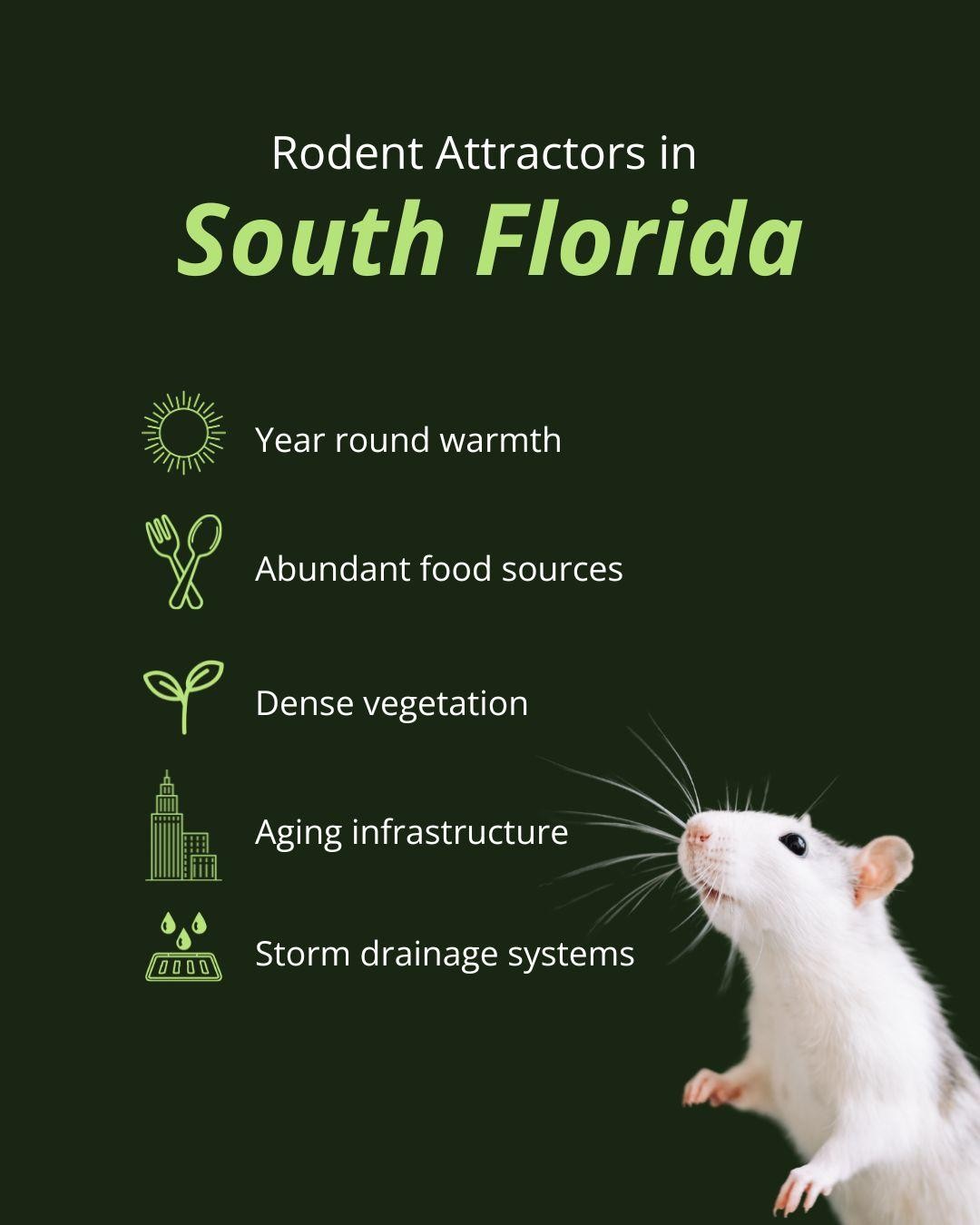
Year-round warmth means there is no annual population reset. Rodents do not hibernate, and temperatures here rarely drop low enough to suppress outdoor populations. Colonies remain active and reproducing throughout all twelve months in ways that simply do not happen in northern states.
Abundant food sources sustain outdoor populations at high levels before rodents ever need to enter a structure. Fruit-bearing trees, open compost, unsecured garbage, pet food left outdoors, and organic debris throughout the subtropical landscape all contribute. Roof rats in particular are strongly attracted to the citrus, mango, and avocado trees common throughout South Florida Counties.
Dense vegetation and mature landscaping reduce the open space that would otherwise expose rodents to predation and detection. Overgrown shrubs along a foundation, branches touching a roofline, and heavy ground cover near exterior walls all create travel corridors that bring rodents directly to a structure's entry points.
Aging infrastructure and varied construction mean gaps and deteriorated seals are common. A gap as small as half an inch is enough for a rat to pass through. South Florida's mix of midcentury concrete block homes, wood-frame construction, and older tile-roof villas means there is no shortage of exploitable openings.
Canals and storm drainage systems give Norway rats an extensive network of travel corridors and harborage sites. Populations along canal banks and under concrete near waterways are a consistent source of pressure on nearby homes and commercial properties throughout the region.
Signs of a Rodent Problem in Your South Florida Home
Rodents are most active at night and stay out of sight during the day, so most infestations are identified through secondary signs before the animal itself is seen.
Signs of a rodent problem in your South Florida home include:
Droppings: Rat droppings are roughly the size of a grape seed and dark brown to black; mouse droppings are smaller, about the size of a grain of rice, and pointed at both ends.
Gnaw marks: Found on food packaging, baseboards, or wiring insulation, indicating active movement.
Grease smudges: Left by the oils in a rodent's fur along walls and baseboards where they travel repeatedly.
Scratching or scurrying sounds: Heard in walls or ceilings at night, a strong indicator of roof rat activity.
Nesting material: Found in attics or inside appliances, showing rodents have established living spaces.
Pet behavior: Pets fixating on a specific wall or cabinet often signal rodent presence before humans notice.
The Risks Rodents Pose: How They Transmit Diseases
Rodents are not simply unpleasant. They pose real, documented risks to structures and health.
Roof rats chew through attic insulation, A/C ducts, and electrical wiring. Chewed wiring is a legitimate fire hazard and one of the more serious consequences of an unaddressed infestation. Norway rats can undermine concrete slabs through burrowing and damage underground plumbing and utility lines.
Rodents contaminate far more food than they consume. Their urine, droppings, and hair are deposited wherever they travel, including across food preparation surfaces and inside pantry cabinets. A single mouse produces dozens of droppings per day.
Rodents are also known vectors for leptospirosis, salmonellosis, and rat-bite fever, either directly through contact with waste or indirectly through the fleas and ticks they carry into a structure.
Rodents: Differences Between Mice and Rats
It’s common to hear the terms “rodents,” “rats,” and “mice” used interchangeably, but they refer to different classifications within the animal kingdom.
Rodents are a large order of mammals known as Rodentia, encompassing over 2,000 species worldwide. This group includes many rodent species such as squirrels, guinea pigs, prairie dogs, and, of course, rats and mice.
Rodents share defining characteristics like a single pair of continuously growing incisors in both the upper and lower jaws, which they must gnaw to keep from overgrowing. Most rodents are small mammals with robust bodies, short limbs, and long tails, and they inhabit a wide range of environments, including temperate regions and tropical areas like South Florida.
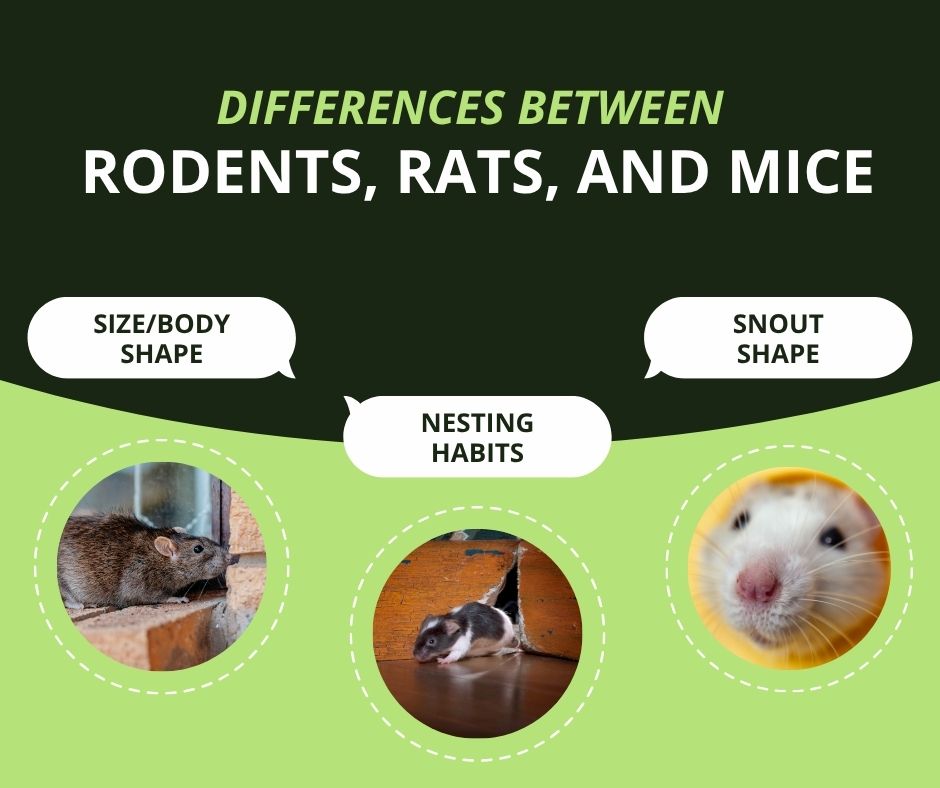
Rats are a subset of rodents, typically larger and more robust than mice. The most common species in South Florida are the Norway rat and the roof rat. Rats generally have blunt snouts, thick bodies, and shorter hind feet relative to their body size. They are known for their burrowing and climbing abilities and tend to be cautious but adaptable.
Rats are often associated with urban and suburban environments and can cause significant structural damage due to their gnawing habits.
Mice, on the other hand, are smaller rodents, such as the house mouse, which is prevalent in South Florida homes. Mice have slender bodies, pointed snouts, large ears, and long hind feet. They are highly curious and can squeeze through very small openings, making them difficult to exclude from buildings. Mice primarily nest close to food sources and reproduce rapidly.
In summary, while all rats and mice are rodents, not all rodents are rats or mice. Recognizing these distinctions helps in understanding their behaviors and implementing the right control measures to protect your home.
Rodent Prevention Tips for South Florida Properties
Prevention is more effective and less expensive than responding to an established infestation. Because the conditions that attract rodents here are year-round, prevention requires consistent attention rather than seasonal effort.
To prevent rodent infestations in your South Florida property, follow these key steps:
Trim vegetation: Keep tree branches several feet away from the roofline and maintain shrubs away from the foundation to reduce rodent access.
Secure all food sources: Store outdoor garbage in sealed containers, bring pet food indoors after feeding, and promptly pick up fallen fruit from trees.
Seal entry points: Use materials rodents cannot chew through, such as steel wool combined with caulk, hardware cloth, or metal flashing. Inspect the exterior for gaps around pipes, vents, A/C line sets, soffits, and doors.
Address moisture issues: Fix leaks, improve drainage, and eliminate standing water near the foundation to make your property less attractive to rodents.
Related Questions To Explore
What is the most common rodent found in South Florida homes? The roof rat is by far the most common rodent found inside South Florida homes. Its ability to climb and access structures through rooflines, soffits, and utility lines makes it uniquely well-suited to the region's mature tree canopy and tile-roof construction. If you are hearing scratching in your ceiling at night, a roof rat inspection is the right first step.
How do rodents get into my home? Rodents enter your home through gaps as small as a quarter of an inch around pipes, vents, A/C line sets, garage doors, soffits, and roofline edges. In South Florida, overhanging tree branches and utility lines give roof rats direct access to the upper portions of a home. A professional rodent exclusion service identifies and seals these entry points as part of a complete treatment plan.
Can rodents in my attic cause a fire? Yes. Roof rats routinely gnaw through electrical wiring in attics, and chewed insulation on live wires is a documented cause of residential fires. If you have an active rodent infestation in your attic, having the wiring inspected after treatment is a smart precaution. Radix Pest Solutions can assess the extent of attic damage as part of our rodent control service.
Is one rodent treatment enough to solve the problem? For most established infestations, a single treatment is not sufficient. Effective rodent control requires trapping or baiting to reduce the active population, exclusion work to seal entry points, and at least one follow-up visit to confirm the infestation has been fully resolved. Radix offers follow-up monitoring as part of our rodent treatment plans to make sure the problem does not return.
Do rodents come back after pest control treatment? They can, if entry points are not fully sealed or if the property conditions that attracted them in the first place have not changed. Trimming vegetation away from the structure, securing food sources, and addressing any remaining gaps after treatment are all essential to long-term success. Our team walks you through these steps as part of every rodent service.
When to Call a Rodent Control Professional
Call a pest control professional if you find droppings in multiple areas of your home, if traps are not producing consistent results, if you hear activity in your ceiling or walls that does not resolve, or if you have identified entry points but are uncertain how to seal them properly.
Roof rat infestations in South Florida attics almost always require a combination of professional trapping, exclusion work, and follow-up monitoring. Commercial properties and food service facilities benefit from ongoing monitoring programs rather than reactive treatment alone.
At Radix Pest Solutions, we address rodent problems at their source throughout Broward, Miami-Dade, and Palm Beach County. Whether you are dealing with roof rats in a Pompano Beach attic, Norway rats near a Hollywood commercial property, or house mice in a Miami home, our team has the tools and experience to resolve it properly and keep it resolved.
Conclusion
Rodents are among the most adaptable pests on the planet, and South Florida's climate, landscape, and infrastructure give them just about everything they need to thrive year-round. Understanding what a rodent is, which species are most relevant to this region, and what drives them toward homes and businesses is the foundation for making smarter decisions about prevention and control.
Whether you are dealing with roof rats in your attic, Norway rats near a canal-adjacent foundation, or house mice working their way through gaps in your kitchen, the approach that works is the same: address the entry points, eliminate the attractants, and bring in a professional when the problem is established enough to require it.
At Radix Pest Solutions, we serve homeowners and businesses throughout Broward, Miami-Dade, and Palm Beach County with rodent control solutions that get to the root of the problem.
Most people have a general idea of what a rodent is. Rats and mice come to mind immediately, and for good reason. But in South Florida, the rodent picture is more specific and more persistent than most homeowners realize.
In Broward, Miami-Dade, and Palm Beach County, Radix Pest Solutions knows that rodents do not wait for winter to push indoors. The warm climate, abundant food sources, dense landscaping, and varied construction styles throughout the region support rodent activity in every season.
What Is a Rodent? Definition and Key Traits
Rodents are a group of mammals characterized by a single pair of continuously growing incisors in each of the upper and lower jaws. They are typically small animals with robust bodies, short limbs, and long tails. A rodent is a mammal belonging to the order Rodentia, the largest group of mammals on Earth, with more than 2,000 identified species.
What sets them apart is a single defining trait: a pair of continuously growing incisors in both the upper and lower jaw. These teeth never stop growing, which means rodents must constantly gnaw on hard materials to wear them down.
This is not a nuisance habit. It is a biological necessity, and it is the primary reason rodents cause structural damage to homes, businesses, and infrastructure. They will chew through wood, drywall, insulation, and electrical wiring because they must.
Rodents are also warm-blooded, give birth to live young, and reproduce at remarkable rates. A single pair of mice can produce dozens of offspring in a year, which is a significant part of why populations escalate quickly once rodents establish themselves inside a structure. Rodents generally have well-developed senses of smell and hearing.
The Rodent Species That Matter in South Florida Homes
Three species account for the vast majority of rodent problems in Broward, Miami-Dade, and Palm Beach County.
Roof Rat (Rattus rattus) is the species most commonly found inside South Florida homes. Slimmer and more agile than the Norway rat, with a body length of 6 to 8 inches and a tail longer than its body, roof rats are exceptional climbers.
They access structures from above using tree branches, utility lines, and overhanging vegetation, then settle into attics, ceiling voids, and wall cavities. Scratching sounds in the ceiling at night are one of the most common signs of their presence. South Florida's dense tree canopy and fruit-bearing trees like citrus, avocado, and mango provide exactly the food sources roof rats seek.
Norway Rat (Rattus norvegicus) is larger and heavier, reaching 7 to 10 inches in body length. Rather than climbing, Norway rats burrow along foundations, under slabs, and near water sources. They are strong swimmers, which matters in a region defined by canals, drainage systems, and waterways.
Norway rats are most commonly found at ground level and below, in crawl spaces, utility vaults, and along the edges of structures near standing water.
House Mouse (Mus musculus) is much smaller, typically 2 to 4 inches in body length, and capable of squeezing through a gap as small as a quarter of an inch. House mice are a consistent presence in residential neighborhoods, restaurants, and retail environments, typically nesting close to food sources in kitchens, pantries, and storage areas.
Why South Florida Creates Ideal Conditions for Rodent Infestations
The biology of rodents is only half the story. South Florida's environment checks nearly every box a rodent needs to thrive.
Year-round warmth means there is no annual population reset. Rodents do not hibernate, and temperatures here rarely drop low enough to suppress outdoor populations. Colonies remain active and reproducing throughout all twelve months in ways that simply do not happen in northern states.
Abundant food sources sustain outdoor populations at high levels before rodents ever need to enter a structure. Fruit-bearing trees, open compost, unsecured garbage, pet food left outdoors, and organic debris throughout the subtropical landscape all contribute. Roof rats in particular are strongly attracted to the citrus, mango, and avocado trees common throughout South Florida Counties.
Dense vegetation and mature landscaping reduce the open space that would otherwise expose rodents to predation and detection. Overgrown shrubs along a foundation, branches touching a roofline, and heavy ground cover near exterior walls all create travel corridors that bring rodents directly to a structure's entry points.
Aging infrastructure and varied construction mean gaps and deteriorated seals are common. A gap as small as half an inch is enough for a rat to pass through. South Florida's mix of midcentury concrete block homes, wood-frame construction, and older tile-roof villas means there is no shortage of exploitable openings.
Canals and storm drainage systems give Norway rats an extensive network of travel corridors and harborage sites. Populations along canal banks and under concrete near waterways are a consistent source of pressure on nearby homes and commercial properties throughout the region.
Signs of a Rodent Problem in Your South Florida Home
Rodents are most active at night and stay out of sight during the day, so most infestations are identified through secondary signs before the animal itself is seen.
Signs of a rodent problem in your South Florida home include:
Droppings: Rat droppings are roughly the size of a grape seed and dark brown to black; mouse droppings are smaller, about the size of a grain of rice, and pointed at both ends.
Gnaw marks: Found on food packaging, baseboards, or wiring insulation, indicating active movement.
Grease smudges: Left by the oils in a rodent's fur along walls and baseboards where they travel repeatedly.
Scratching or scurrying sounds: Heard in walls or ceilings at night, a strong indicator of roof rat activity.
Nesting material: Found in attics or inside appliances, showing rodents have established living spaces.
Pet behavior: Pets fixating on a specific wall or cabinet often signal rodent presence before humans notice.
The Risks Rodents Pose: How They Transmit Diseases
Rodents are not simply unpleasant. They pose real, documented risks to structures and health.
Roof rats chew through attic insulation, A/C ducts, and electrical wiring. Chewed wiring is a legitimate fire hazard and one of the more serious consequences of an unaddressed infestation. Norway rats can undermine concrete slabs through burrowing and damage underground plumbing and utility lines.
Rodents contaminate far more food than they consume. Their urine, droppings, and hair are deposited wherever they travel, including across food preparation surfaces and inside pantry cabinets. A single mouse produces dozens of droppings per day.
Rodents are also known vectors for leptospirosis, salmonellosis, and rat-bite fever, either directly through contact with waste or indirectly through the fleas and ticks they carry into a structure.
Rodents: Differences Between Mice and Rats
It’s common to hear the terms “rodents,” “rats,” and “mice” used interchangeably, but they refer to different classifications within the animal kingdom.
Rodents are a large order of mammals known as Rodentia, encompassing over 2,000 species worldwide. This group includes many rodent species such as squirrels, guinea pigs, prairie dogs, and, of course, rats and mice.
Rodents share defining characteristics like a single pair of continuously growing incisors in both the upper and lower jaws, which they must gnaw to keep from overgrowing. Most rodents are small mammals with robust bodies, short limbs, and long tails, and they inhabit a wide range of environments, including temperate regions and tropical areas like South Florida.
Rats are a subset of rodents, typically larger and more robust than mice. The most common species in South Florida are the Norway rat and the roof rat. Rats generally have blunt snouts, thick bodies, and shorter hind feet relative to their body size. They are known for their burrowing and climbing abilities and tend to be cautious but adaptable.
Rats are often associated with urban and suburban environments and can cause significant structural damage due to their gnawing habits.
Mice, on the other hand, are smaller rodents, such as the house mouse, which is prevalent in South Florida homes. Mice have slender bodies, pointed snouts, large ears, and long hind feet. They are highly curious and can squeeze through very small openings, making them difficult to exclude from buildings. Mice primarily nest close to food sources and reproduce rapidly.
In summary, while all rats and mice are rodents, not all rodents are rats or mice. Recognizing these distinctions helps in understanding their behaviors and implementing the right control measures to protect your home.
Rodent Prevention Tips for South Florida Properties
Prevention is more effective and less expensive than responding to an established infestation. Because the conditions that attract rodents here are year-round, prevention requires consistent attention rather than seasonal effort.
To prevent rodent infestations in your South Florida property, follow these key steps:
Trim vegetation: Keep tree branches several feet away from the roofline and maintain shrubs away from the foundation to reduce rodent access.
Secure all food sources: Store outdoor garbage in sealed containers, bring pet food indoors after feeding, and promptly pick up fallen fruit from trees.
Seal entry points: Use materials rodents cannot chew through, such as steel wool combined with caulk, hardware cloth, or metal flashing. Inspect the exterior for gaps around pipes, vents, A/C line sets, soffits, and doors.
Address moisture issues: Fix leaks, improve drainage, and eliminate standing water near the foundation to make your property less attractive to rodents.
Related Questions To Explore
What is the most common rodent found in South Florida homes? The roof rat is by far the most common rodent found inside South Florida homes. Its ability to climb and access structures through rooflines, soffits, and utility lines makes it uniquely well-suited to the region's mature tree canopy and tile-roof construction. If you are hearing scratching in your ceiling at night, a roof rat inspection is the right first step.
How do rodents get into my home? Rodents enter your home through gaps as small as a quarter of an inch around pipes, vents, A/C line sets, garage doors, soffits, and roofline edges. In South Florida, overhanging tree branches and utility lines give roof rats direct access to the upper portions of a home. A professional rodent exclusion service identifies and seals these entry points as part of a complete treatment plan.
Can rodents in my attic cause a fire? Yes. Roof rats routinely gnaw through electrical wiring in attics, and chewed insulation on live wires is a documented cause of residential fires. If you have an active rodent infestation in your attic, having the wiring inspected after treatment is a smart precaution. Radix Pest Solutions can assess the extent of attic damage as part of our rodent control service.
Is one rodent treatment enough to solve the problem? For most established infestations, a single treatment is not sufficient. Effective rodent control requires trapping or baiting to reduce the active population, exclusion work to seal entry points, and at least one follow-up visit to confirm the infestation has been fully resolved. Radix offers follow-up monitoring as part of our rodent treatment plans to make sure the problem does not return.
Do rodents come back after pest control treatment? They can, if entry points are not fully sealed or if the property conditions that attracted them in the first place have not changed. Trimming vegetation away from the structure, securing food sources, and addressing any remaining gaps after treatment are all essential to long-term success. Our team walks you through these steps as part of every rodent service.
When to Call a Rodent Control Professional
Call a pest control professional if you find droppings in multiple areas of your home, if traps are not producing consistent results, if you hear activity in your ceiling or walls that does not resolve, or if you have identified entry points but are uncertain how to seal them properly.
Roof rat infestations in South Florida attics almost always require a combination of professional trapping, exclusion work, and follow-up monitoring. Commercial properties and food service facilities benefit from ongoing monitoring programs rather than reactive treatment alone.
At Radix Pest Solutions, we address rodent problems at their source throughout Broward, Miami-Dade, and Palm Beach County. Whether you are dealing with roof rats in a Pompano Beach attic, Norway rats near a Hollywood commercial property, or house mice in a Miami home, our team has the tools and experience to resolve it properly and keep it resolved.
Conclusion
Rodents are among the most adaptable pests on the planet, and South Florida's climate, landscape, and infrastructure give them just about everything they need to thrive year-round. Understanding what a rodent is, which species are most relevant to this region, and what drives them toward homes and businesses is the foundation for making smarter decisions about prevention and control.
Whether you are dealing with roof rats in your attic, Norway rats near a canal-adjacent foundation, or house mice working their way through gaps in your kitchen, the approach that works is the same: address the entry points, eliminate the attractants, and bring in a professional when the problem is established enough to require it.
At Radix Pest Solutions, we serve homeowners and businesses throughout Broward, Miami-Dade, and Palm Beach County with rodent control solutions that get to the root of the problem.
Check Out What Our Pest Free Customers Have To Say

Emerald Tower Association, Inc
Pompano Beach, Florida

Highly recommend them. We had issues with raccoons and Jonathan immediately came out and placed cages around the property. Caught several raccoons. Thank you Jonathan for your excellent service.

Darcy Miller
Pompano Beach, Florida
I would definitely recommend Radix Pest Solutions. Jonathan is very professional, reliable and punctual. He absolutely knows this business and takes pride in his work.

Jason Shervinski
Pompano Beach, Florida
We have had Jonathan as our exterminator for well over 7 years. We could not think of a better Pest Control company for all of properties and needs. Jonathan is prompt, detailed, and reasonable. If you are searching for a quality Pest Control Company as a one time or on a recurring basis you found it in Radix!

Emily Acevedo
Pompano Beach, Florida
Jonathan was very professional and knowledgeable, he listened and then proceeded to address the concerns. He provided excellent service and explained the process, completed it quickly and efficiently. I will be using this company again and recommend to anyone with a pest problem.

Killgates Covidlie
Pompano Beach, Florida
I’ve known Jonathan for over five years. On how he took care of us during a complete termite infestation is no less than perfection. There no one like him, bar none. His honesty, reliability, hard work and dedication and punctuality. I feel privileged that I was lucky enough to have found him to use his service, because they don’t exist like him. Thank you Jonathan.
Daisy Maestre
Pompano Beach, Florida
It’s the best pest control company that I’ve dealt with, Jonathan is knowledgeable, always prompt, courteous and thorough and very affordable. I highly recommend him…. Give him a call you won’t regret it… 😊
Emerald Tower Association, Inc
Pompano Beach, Florida
Highly recommend them. We had issues with raccoons and Jonathan immediately came out and placed cages around the property. Caught several raccoons. Thank you Jonathan for your excellent service.
Darcy Miller
Pompano Beach, Florida
I would definitely recommend Radix Pest Solutions. Jonathan is very professional, reliable and punctual. He absolutely knows this business and takes pride in his work.
Jason Shervinski
Pompano Beach, Florida
We have had Jonathan as our exterminator for well over 7 years. We could not think of a better Pest Control company for all of properties and needs. Jonathan is prompt, detailed, and reasonable. If you are searching for a quality Pest Control Company as a one time or on a recurring basis you found it in Radix!
Emily Acevedo
Pompano Beach, Florida
Jonathan was very professional and knowledgeable, he listened and then proceeded to address the concerns. He provided excellent service and explained the process, completed it quickly and efficiently. I will be using this company again and recommend to anyone with a pest problem.
Killgates Covidlie
Pompano Beach, Florida
I’ve known Jonathan for over five years. On how he took care of us during a complete termite infestation is no less than perfection. There no one like him, bar none. His honesty, reliability, hard work and dedication and punctuality. I feel privileged that I was lucky enough to have found him to use his service, because they don’t exist like him. Thank you Jonathan.
Daisy Maestre
Pompano Beach, Florida
It’s the best pest control company that I’ve dealt with, Jonathan is knowledgeable, always prompt, courteous and thorough and very affordable. I highly recommend him…. Give him a call you won’t regret it… 😊
Emerald Tower Association, Inc
Pompano Beach, Florida
Highly recommend them. We had issues with raccoons and Jonathan immediately came out and placed cages around the property. Caught several raccoons. Thank you Jonathan for your excellent service.
Darcy Miller
Pompano Beach, Florida
I would definitely recommend Radix Pest Solutions. Jonathan is very professional, reliable and punctual. He absolutely knows this business and takes pride in his work.
Jason Shervinski
Pompano Beach, Florida
We have had Jonathan as our exterminator for well over 7 years. We could not think of a better Pest Control company for all of properties and needs. Jonathan is prompt, detailed, and reasonable. If you are searching for a quality Pest Control Company as a one time or on a recurring basis you found it in Radix!
Emily Acevedo
Pompano Beach, Florida
Jonathan was very professional and knowledgeable, he listened and then proceeded to address the concerns. He provided excellent service and explained the process, completed it quickly and efficiently. I will be using this company again and recommend to anyone with a pest problem.
Killgates Covidlie
Pompano Beach, Florida
I’ve known Jonathan for over five years. On how he took care of us during a complete termite infestation is no less than perfection. There no one like him, bar none. His honesty, reliability, hard work and dedication and punctuality. I feel privileged that I was lucky enough to have found him to use his service, because they don’t exist like him. Thank you Jonathan.
Daisy Maestre
Pompano Beach, Florida
It’s the best pest control company that I’ve dealt with, Jonathan is knowledgeable, always prompt, courteous and thorough and very affordable. I highly recommend him…. Give him a call you won’t regret it… 😊
Emerald Tower Association, Inc
Pompano Beach, Florida
Highly recommend them. We had issues with raccoons and Jonathan immediately came out and placed cages around the property. Caught several raccoons. Thank you Jonathan for your excellent service.
Darcy Miller
Pompano Beach, Florida
I would definitely recommend Radix Pest Solutions. Jonathan is very professional, reliable and punctual. He absolutely knows this business and takes pride in his work.
Jason Shervinski
Pompano Beach, Florida
We have had Jonathan as our exterminator for well over 7 years. We could not think of a better Pest Control company for all of properties and needs. Jonathan is prompt, detailed, and reasonable. If you are searching for a quality Pest Control Company as a one time or on a recurring basis you found it in Radix!
Emily Acevedo
Pompano Beach, Florida
Jonathan was very professional and knowledgeable, he listened and then proceeded to address the concerns. He provided excellent service and explained the process, completed it quickly and efficiently. I will be using this company again and recommend to anyone with a pest problem.
Killgates Covidlie
Pompano Beach, Florida
I’ve known Jonathan for over five years. On how he took care of us during a complete termite infestation is no less than perfection. There no one like him, bar none. His honesty, reliability, hard work and dedication and punctuality. I feel privileged that I was lucky enough to have found him to use his service, because they don’t exist like him. Thank you Jonathan.
Daisy Maestre
Pompano Beach, Florida
It’s the best pest control company that I’ve dealt with, Jonathan is knowledgeable, always prompt, courteous and thorough and very affordable. I highly recommend him…. Give him a call you won’t regret it… 😊


We offer a range of professional pest control services to residential and commercial clients. Our experienced team is dedicated to keeping your property pest-free with minimal disruption to your daily life.
Phone:
E-mail:
Locations:
1940 NW 1st Ave
Pompano Beach, FL 33060
2131 Hollywood Blvd, Ste 306
Hollywood, FL 33020
2829 SW 67th Ave
Miami, FL 33155
Hours
Monday - Saturday
07:00 am – 05:00 pm
Sun Closed
*Closed All Major Holidays*
Our Services
We offer a range of professional pest control services to residential and commercial clients. Our experienced team is dedicated to keeping your property pest-free with minimal disruption to your daily life.
Phone:
E-mail:
Locations:
1940 NW 1st Ave
Pompano Beach, FL 33060
2131 Hollywood Blvd, Ste 306
Hollywood, FL 33020
2829 SW 67th Ave
Miami, FL 33155
Hours
Monday - Saturday
07:00 am – 05:00 pm
Sun Closed
*Closed All Major Holidays*
Our Services
We offer a range of professional pest control services to residential and commercial clients. Our experienced team is dedicated to keeping your property pest-free with minimal disruption to your daily life.
Phone:
E-mail:
Locations:
1940 NW 1st Ave
Pompano Beach, FL 33060
2131 Hollywood Blvd, Ste 306
Hollywood, FL 33020
2829 SW 67th Ave
Miami, FL 33155
Hours
Monday - Saturday
07:00 am – 05:00 pm
Sun Closed
*Closed All Major Holidays*
Our Services
We offer a range of professional pest control services to residential and commercial clients. Our experienced team is dedicated to keeping your property pest-free with minimal disruption to your daily life.
Phone:
E-mail:
Locations:
1940 NW 1st Ave
Pompano Beach, FL 33060
2131 Hollywood Blvd, Ste 306
Hollywood, FL 33020
2829 SW 67th Ave
Miami, FL 33155
Hours
Monday - Saturday
07:00 am – 05:00 pm
Sun Closed
*Closed All Major Holidays*
Our Services